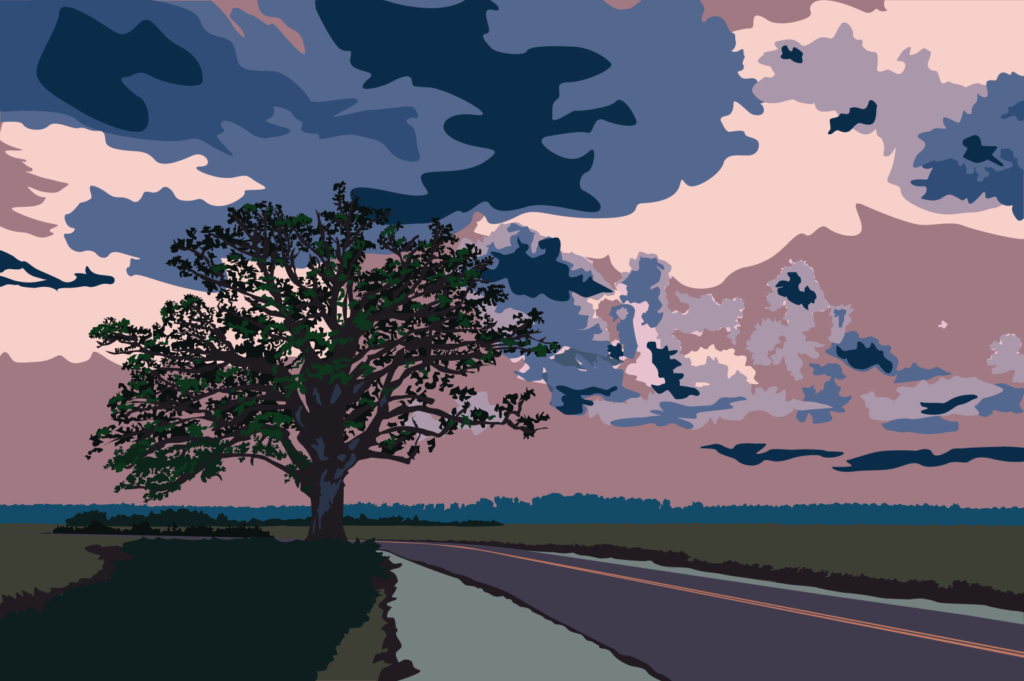
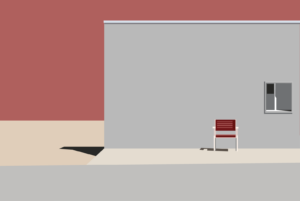
The bur oak at McBaine, from the road shoulder, with the sky taking up most of the picture.
Notes
Nothing else out there to compare it to
The bottomland around McBaine is flat and mostly cleared, so this tree stands with nothing near it. That’s the whole reason it reads the way it does – no other canopy at that height, no buildings, nothing to measure it against except the road running past. A tree this size in a woodlot would just be a tree.
It’s a bur oak, roughly 350 to 400 years old, about ninety feet tall with a crown near 130 feet across. It was already mature when Lewis and Clark came up the Missouri in 1804. Bur oaks get to be the last tree standing in a floodplain for a reason: thick corky bark that shrugs off fire, deep roots, and a tolerance for both drought and standing water that most hardwoods don’t have. This one has taken the 1993 flood, lightning more than once, and an internal fire in 2020. Trees don’t heal, they seal – they wall off the damage and keep growing around it.
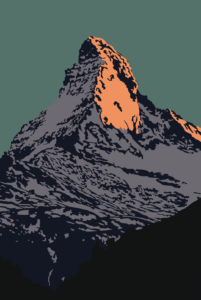
The sky is three-quarters of the frame, and that puts the tree entirely in silhouette. No light coming through the canopy, no lit side, no modeling. Every branch, every gap, every bit of structure has to come from the shape of the negative space between leaves. Same problem as drawing snowfields on a mountain – the subject is described by what isn’t filled in.
Eight flat colors and the sky uses most of them. Two blues, two dusty roses, a lavender, and the pale band at the horizon – layered into flat cloud shapes with hard edges, no gradients anywhere. The canopy is a couple of greens over black structure. The centerline stripe is the only warm accent in the whole picture and the only thing that isn’t nature. It’s also what makes the road read as a road rather than a grey wedge.