Palette
| Deep blue | #103051 | |
| Red | #F59490 | |
| Teal | #299AA0 |
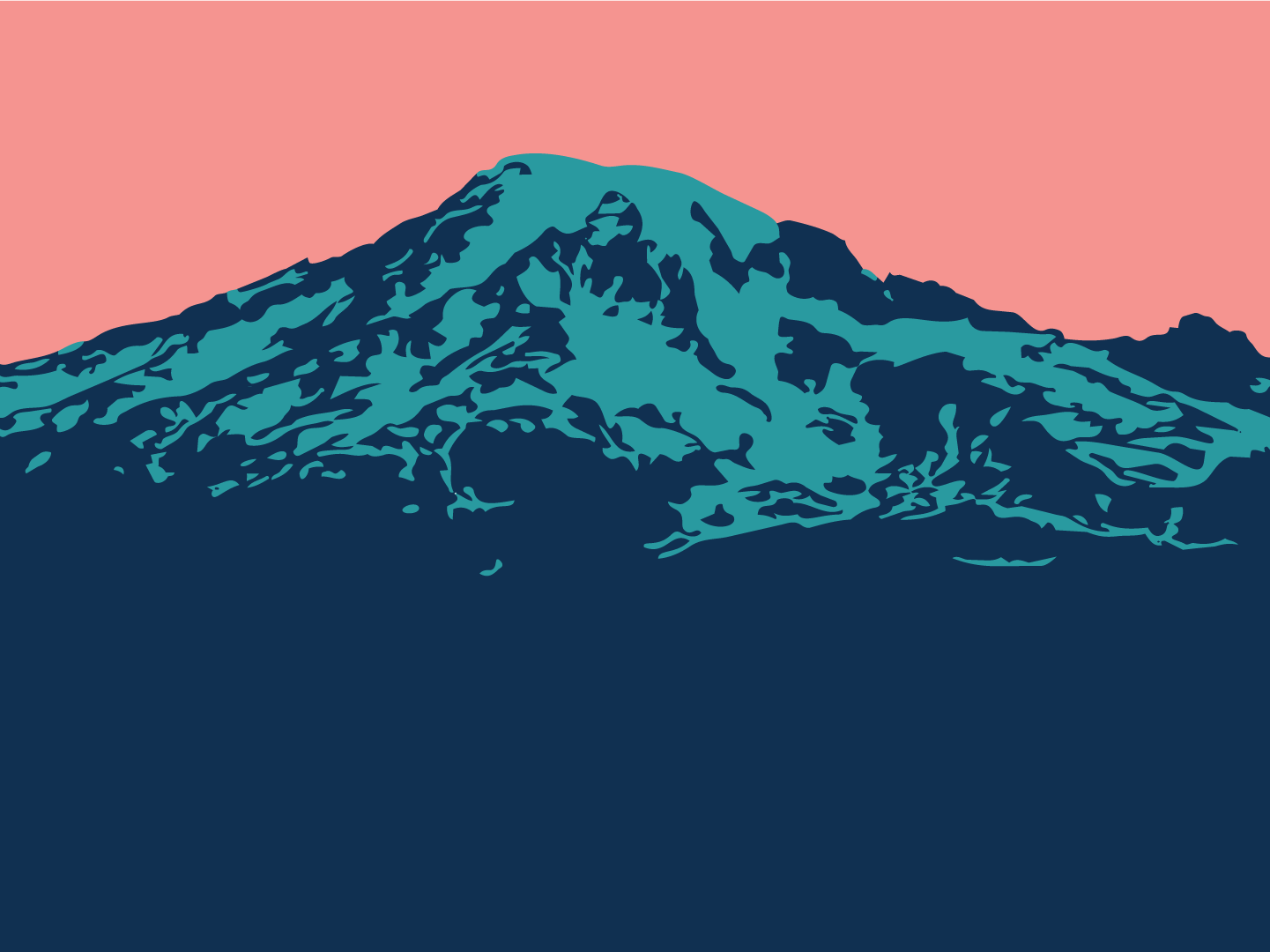
Rainier in three colors, with the ice doing everything.
Notes
Only two shapes in the whole thing
Three colors, and one of them is sky. Which leaves a dark and a teal to build an entire 14,000-foot volcano out of – no third value, no shadow side, no distance haze. Every bit of shape in this mountain comes from one boundary: where the ice stops and the rock starts.
That boundary isn’t arbitrary, which is why it can carry the weight. Rainier has 26 named glaciers over roughly 29 square miles – more ice than every other Cascade volcano put together – and ice goes where the mountain’s shape tells it to. It fills the radiating valleys between ridges and thins out over the ribs. So the teal fingers running down the flanks are the drainages, and the dark between them is the high ground. Draw the ice right and you’ve drawn the topography.
The same ice is why Rainier is considered one of the more dangerous volcanoes in the country, and not for the reason people assume. The hazard isn’t lava. It’s that a lot of loose volcanic rock sitting under a lot of ice can turn into a lahar – a fast mudflow that follows river valleys into towns that are a long way from the mountain. There are sirens in those valleys.
Three flat colors. The pink sky is the only invented one and it’s doing a specific job: pushing the mountain forward. A cool sky would let the dark navy recede and the whole silhouette would soften. Warm against cool holds the edge hard. There’s no foreground, no scale reference, nothing below the treeline – just the profile and the pattern on it.