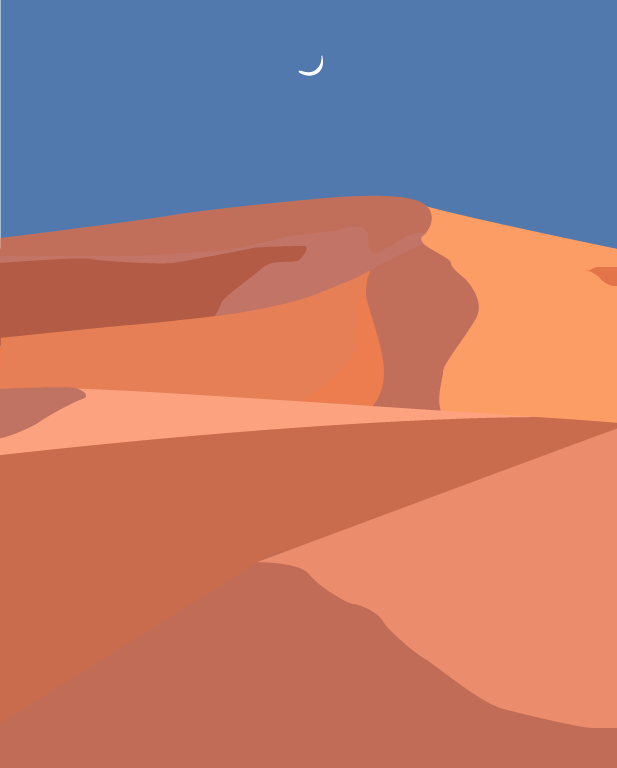
Seven colors of sand, stacked into planes, with a daytime moon that showed up early.
Notes
One material, seven values
Everything below the sky is the same substance. Same grain, same color, one hill. All the shape in this picture comes from which direction each face happens to be pointing, and that’s the entire subject.
Dunes are built to a formula. Wind pushes grains up the shallow side, they pile at the top until the slope hits about thirty-four degrees, and then the far side collapses into an avalanche and resets. That angle is fixed – it’s a property of sand, not of any particular desert – which is why the steep faces here all lean at the same pitch. The long shallow ramps face the wind. The short abrupt ones are where it stopped mattering.
No horizon in the frame. The dune fills the bottom two-thirds and the sky just sits on top of it, so there’s no distance cue anywhere – this could be forty feet of sand or four hundred. The crescent is the only thing that fixes a scale, and it fixes it wrong, which is why it’s in there. It’s also the sole cool object in a picture that’s otherwise entirely warm.
Seven flat colors, and the whole thing depends on their order. Sand in real life is a continuous gradient with no edges in it at all, so every boundary here is invented – a decision about where one plane quits and the next starts. Get the sequence wrong by one step and the dune inverts, the ridge becomes a valley, and the picture reads as fabric.